
The average cost of a funeral is $8,300 with viewing and burial or $6,280 with viewing and cremation, the national medians in the National Funeral Directors Association’s 2023 study. Add a burial vault and the burial figure becomes $9,995. Those medians cover the funeral home only. The cemetery plot, grave opening, headstone, flowers, and obituary are billed separately and can add several thousand dollars. Some people look this up while sitting with a loss, others early, so the people they love never have to.
Key numbers
- $8,300
- Median funeral with viewing and burial (NFDA, 2023)
- $6,280
- Median funeral with viewing and cremation (NFDA, 2023)
- $9,995
- Median burial funeral with a vault added (NFDA, 2023)
- $2,495
- Median basic services fee, the one line you cannot decline (NFDA, 2023)
- $10,800 to $22,300
- Burial funeral once a cemetery is added, our arithmetic (NFDA and FCA ranges)
- $255
- One-time Social Security death payment (SSA)
National medians; your area will differ. FCA is the Funeral Consumers Alliance.
Funeral costs adding up? Walk through them with us. A free, no-pressure conversation with a licensed professional, so your family never has to guess.
The average cost of a funeral, and how much a funeral costs by type
The clearest national number comes from the National Funeral Directors Association, the largest organization of funeral professionals in the country. Its 2023 General Price List Study puts the median funeral at $8,300 for burial and $6,280 for cremation, each figure including a viewing and a ceremony. The NFDA surveyed 5,219 funeral homes and received 809 responses.
“Median” simply means the middle: half of funerals cost more, half cost less. It’s a steadier guide than an average, which a few very large or very small funerals can pull off-center. Here are the headline figures at a glance:
| Type of funeral | National median (NFDA, 2023) or noted source |
|---|---|
| Funeral with viewing and burial | $8,300 |
| …with a burial vault added | $9,995 |
| Funeral with viewing and cremation | $6,280 |
| Direct cremation (no viewing or ceremony) | About $1,924 nationally (Funeralocity, 2026); the FCA calls $700 to $1,400 reasonable |
| Burial in a VA national cemetery, eligible veteran | Gravesite, opening, liner, and marker at no cost; funeral home charges still apply |
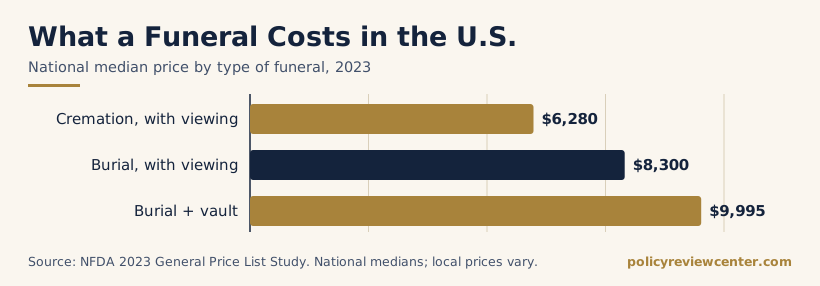
One piece of good news. Over the two years measured, overall inflation was 13.6%, while the median cost of a burial funeral rose 5.8% (from $7,848) and a cremation funeral 8.1% (from $5,810). Funeral prices rose more slowly than inflation, so a family planning today is not chasing a number that is racing away.
Funeral cost breakdown, line by line
A funeral bill isn’t one number. It’s a stack of individual charges, and every funeral home is required to show them to you separately. Here is the NFDA’s median for each line in a burial funeral, the items that add up to that $8,300:
| Line item | NFDA median (2023) |
|---|---|
| Basic services fee (non-declinable) | $2,495 |
| Transfer of remains to funeral home | $395 |
| Embalming | $845 |
| Other preparation of the body | $295 |
| Use of facilities & staff for viewing | $475 |
| Use of facilities & staff for ceremony | $550 |
| Hearse | $375 |
| Service car / van | $175 |
| Basic memorial printed package | $195 |
| Metal burial casket | $2,500 |
| Median total, funeral with burial | $8,300 |
| Burial vault (optional add-on) | $1,695 |
| Median total, burial with vault | $9,995 |
Source: National Funeral Directors Association, 2023 General Price List Study (published December 2023). National medians; your area will differ. Cemetery plot, headstone, flowers, and obituary are not included.
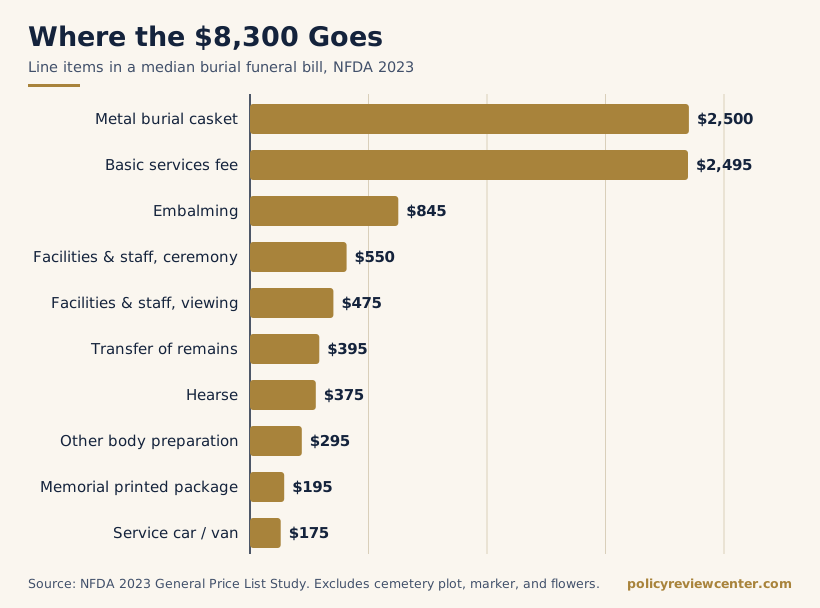
Two lines carry the most weight: the basic services fee (the funeral director’s professional charge, which the rules don’t let you decline) and the casket, where the range is widest. Together they are $4,995 of the $8,300, about 60 percent. The median metal casket sits at $2,500, and you are free to choose below it. Our casket price guide covers the range and where else you can buy one.

What the median includes, and what it leaves out
This is the question behind most surprise bills. The NFDA median covers what the funeral home itself provides. Everything a third party charges, or that you add, sits on top.
| In the $8,300 funeral home median | Billed separately, on top |
|---|---|
| Basic services fee, transfer of remains, embalming, other body preparation | Cemetery plot or grave space |
| Use of facilities and staff for viewing and for ceremony | Opening and closing the grave |
| Hearse and service car | Headstone or grave marker |
| Basic memorial printed package | Flowers and obituary notices (cash-advance items) |
| A metal burial casket ($2,500 median) | Clergy or musician honoraria, death certificates, reception |
| Total: the $8,300 median | A burial vault ($1,695 median, an optional add-on) or a cemetery grave liner |
Sources: NFDA 2023 General Price List Study for the left column. The NFDA says its figures exclude cemetery interment, monuments and markers, and cash-advance charges such as flowers and obituaries; cash-advance examples are from the FTC Funeral Rule.
The cash-advance items in the right column are things the funeral home buys on your behalf, and the FTC says they must be listed separately on your statement. The cemetery lines are covered in our burial plot cost guide, which includes two real city price lists. If you are weighing a viewing, our embalming cost guide explains the $845 line.
Worked example: the full burial total
The funeral home’s $8,300 is not the whole bill. The NFDA says plainly that its figures leave out cemetery interment, monuments and grave markers, and cash-advance charges such as flowers and obituaries. To see the real total, add the cemetery side, using the ranges the nonprofit Funeral Consumers Alliance publishes in its cemetery and traditional burial guides.
Say Maria is arranging a burial for her father and gets two quotes, one from a small nonprofit cemetery in a rural county and one from a for-profit cemetery in a large city. The funeral home bill is the NFDA median in both cases. Here is how the totals build (to try your own numbers, use our funeral cost calculator):
| Line | Rural nonprofit cemetery | Urban for-profit cemetery |
|---|---|---|
| Funeral home median, burial with viewing (NFDA) | $8,300 | $8,300 |
| Grave space | $500 | $5,000 to $10,000 |
| Opening and closing the grave | $300 to $500 | $300 to $1,500 |
| Grave liner or vault | $700 to $1,500 | $700 to $1,500 |
| Marker with engraving and setting | About $1,000 | About $1,000 |
| Total before flowers, obituary, reception | $10,800 to $11,800 | $15,300 to $22,300 |
Illustrative arithmetic, not a quote. Funeral home line: NFDA 2023 General Price List Study. Cemetery lines: Funeral Consumers Alliance, Guide to Cemetery Purchases (11/20 rev.) and Traditional Burial (12/20 rev.). Your cemetery’s own price list is the only number that is truly yours.
Same funeral home, same casket, and the totals sit about $4,500 to $10,500 apart. The cemetery decides the difference, which is why a plot price and an opening-and-closing fee are worth asking for before anything is signed. Two more things worth knowing. The Funeral Consumers Alliance notes that no state law requires a vault, though many cemeteries do, so ask what your cemetery requires. And in the rural column the grave liner is counted once, not on top of the NFDA’s separate $1,695 vault line.
Now a second example, on the funeral home side. Say the family prefers a graveside service with a closed casket and a private family viewing. They decline embalming ($845), other body preparation ($295), and the public viewing room ($475). Starting from the $8,300 median, that removes $1,615 and leaves $6,685. Two cautions. This is arithmetic on medians, not a quote, and a graveside service fee that the median does not include would be added back. And the FTC notes that many funeral homes have a policy requiring embalming for a public viewing, though not required by law in most states, so ask whether a private viewing without embalming is offered.
Why the same funeral costs more or less in different places
A median is the middle of a wide spread. In 2015 the Funeral Consumers Alliance and the Consumer Federation of America gathered the price lists of 150 funeral homes in 10 regions, and a full-service funeral ran from $2,580 to $13,800, according to a summary of that survey. That survey is old and prices have moved, but the shape has not. Two homes in the same area can differ by thousands for the same list of items.
Four things move your number the most: which funeral home you call, which cemetery you choose (the worked example above is a $4,500 to $10,500 swing), whether you want a public viewing with embalming and facility rooms, and the casket. A fifth is easy to miss. The NFDA study reports national medians, and the group notes that costs for goods and services vary by region.
What about funeral cost by state? NFDA’s state-level medians sit in a paid report, and many 50-state tables online come from small samples or modeled estimates, so we do not print one here. Our funeral and cremation cost by state guide prints only prices we can trace to a named survey, and says so when a state has none.
Burial vs. cremation: where the difference comes from
Cremation runs $2,020 less than burial at the median ($6,280 against $8,300), and the gap traces to a few specific lines. A cremation funeral replaces the metal casket with an alternative container and an urn, and it often involves no cemetery plot. The professional services, viewing, and ceremony can be just as full.
The most economical choice of all is a direct cremation: the cremation itself, without a viewing or formal service, with the family free to hold a memorial whenever and wherever feels right. Our direct cremation cost guide and cremation cost guide give the ranges. Cremation is now the majority choice: the NFDA projects a 63.4% cremation rate and a 31.6% burial rate for 2025. Neither path is more respectful than the other. A natural burial is a third route; our green burial guide prices it.
What a funeral could cost in 10 or 20 years
Families planning ahead often ask this. NFDA’s own two-year change gives a rough pace: from 2021 to 2023 the burial median rose 5.8% (about 2.9% a year) and the cremation median rose 8.1% (about 4.0% a year). The table grows today’s medians at a few steady yearly rates. It is arithmetic, not a forecast, and real prices can rise faster or slower.
| Steady yearly rise | Burial, 10 years | Burial, 20 years | Cremation, 10 years | Cremation, 20 years |
|---|---|---|---|---|
| 2% a year | $10,100 | $12,300 | $7,700 | $9,300 |
| 3% a year | $11,200 | $15,000 | $8,400 | $11,300 |
| 4% a year | $12,300 | $18,200 | $9,300 | $13,800 |
Illustrative arithmetic on the NFDA 2023 medians ($8,300 burial, $6,280 cremation), rounded to the nearest $100. Not a forecast or a quote.
The point is not to alarm anyone. It is to show why the number a family sets aside today may need a margin. Our prepaid funeral plans guide and final expense insurance cost guide look at two ways to plan for it.
Your rights: the FTC Funeral Rule
Federal law is on the family’s side here. The FTC Funeral Rule gives you specific protections at every funeral home in the country, and knowing them ahead of time takes pressure out of a hard moment. In plain terms:
- You can buy only what you want. You don’t have to accept a package. You may choose individual goods and services and decline the rest.
- You can get prices over the phone. A funeral home must share price information by telephone if you ask, and you don’t have to give your name, address, or phone number first.
- You get a General Price List to keep. When you visit in person, the home must hand you an itemized list showing the cost of each item.
- You see the casket price list first. You have the right to a written casket price list before you see the actual caskets, so you can ask about lower-priced models that may not be on display.
- You can supply your own casket or urn. The funeral home can’t refuse one you bought elsewhere, or charge a fee to handle it.
- You get a written statement right after you decide. It lists every good and service you selected, the price of each, and the total.
Two limits are easy to miss. The Rule does not cover third-party sellers such as casket and monument dealers, or cemeteries that lack an on-site funeral home, so the cemetery’s own price list is a separate request. And cash-advance items, meaning things the funeral home buys on your behalf such as flowers, obituary notices, clergy honoraria, and death certificates, must be listed separately on your statement. If the home charges a fee for obtaining them, it must tell you. The FTC found that more than 60 percent of the funeral home websites it reviewed gave little to no price information, and in October 2022 it asked for public comment on whether prices must be posted online. Until that changes, a phone call is the dependable way to compare.
Price-comparison checklist for two or three funeral homes
The FTC publishes a Funeral Costs and Pricing Checklist built for exactly this: copy it and fill in one column per funeral home. These are the lines to ask each one for, and what each choice usually means for the total:
| Ask for | What to confirm | Reference point |
|---|---|---|
| Basic services fee | Cannot be declined. Compare it across homes. | NFDA median $2,495 |
| Embalming | Not required by law for every death. Ask about refrigeration and private viewing. | NFDA median $845 |
| Casket | Ask for the written casket list first. You may bring your own. | NFDA median metal casket $2,500 |
| Burial vault or grave liner | Ask the cemetery whether one is required. | NFDA vault $1,695; FCA liner $700 to $1,500 |
| Viewing and ceremony rooms | Skip what you will not use. | NFDA $475 and $550 |
| Hearse and service car | Ask whether a graveside or smaller service needs both. | NFDA $375 and $175 |
| Direct cremation or immediate burial | Ask for the price of each, so you can see the floor. | Ask for the home’s price |
| Cash-advance items | Flowers, obituary, death certificates. Is there a fee to obtain them? | Listed separately on your statement |
| Cemetery | Request its price list directly. The Funeral Rule does not reach a cemetery with no on-site funeral home. | See the worked example above |
Who pays, and how families plan ahead
Most families cover a funeral one of three ways: savings set aside for it, a pre-need contract with a funeral home, or a small life insurance policy bought for exactly this purpose. Many use a blend. Social Security helps only a little: its one-time death payment is $255, paid to a surviving spouse or, if there is none, certain eligible children, and it must be claimed within two years. That is about 3 percent of the $8,300 median. For eligible veterans, our VA burial benefits guide explains what the government covers.
Money set aside. The simplest path. A dedicated savings account, sometimes a payable-on-death account that passes straight to the person handling arrangements. The advantage is full flexibility; the work is making sure the amount is actually there when it’s needed, and that someone knows where it is.
A pre-need contract. This is arranging (and often paying for) your funeral with a specific funeral home in advance. The appeal is real: you lock in today’s prices and spare your family the decisions. The points to weigh: how your money is protected, what happens if you move or the home changes hands, and whether the plan travels with you. Our prepaid funeral plans guide goes through those questions.
Final expense life insurance. A small whole life policy (often called final expense or burial insurance) sized to cover these costs, with the benefit paid to a person you name rather than tied to one funeral home. It keeps the choices in the family’s hands and the money portable. If you already own a larger policy, it helps to understand how burial and life insurance differ before adding a second one. A free policy review can confirm whether what you have is the right fit and the right size. If a small policy is one option you are weighing, what a final expense policy costs each month shows a real sample, and our guide to what final expense insurance covers shows which of these bills the cash can go toward.
Some families also ask whether any of these costs come back at tax time. Our guide to whether funeral expenses are tax deductible answers that plainly, and the funeral planning checklist lists what to gather before the need arises.
When you do not need to call us
Honest answer: a lot of families do not. We are licensed insurance agents, not a funeral home, and a few situations call for someone else.
- A death has just happened. Call the funeral home first. A life insurance policy we help you set up is for the person buying it; it does not pay for a funeral that has already taken place. If the person who died had a policy, we are glad to help you find the carrier and file the claim, and that part is free.
- You already have the money earmarked. If a savings account, a paid-up pre-need contract, or a policy you already own covers roughly the $8,300 to $11,000 range in this guide, keep it. A review that ends in “keep what you have” is a good review.
- The person who died was a veteran. A VA national cemetery provides the gravesite, opening and closing, and a marker at no cost to an eligible family, which can remove the whole cemetery bill. Start with our VA burial benefits guide and call the funeral home second.
- You are weighing a pre-need contract. Reading it with your own eyes and comparing homes does not require us. If you would like a second set of eyes on how it compares with a small policy, we will give one, with no obligation.
Free · Unhurried · No pressure
Funeral costs adding up? Walk through them with us.
A licensed professional will walk through your options for covering these costs (savings, pre-need, or a small policy) calmly and with no pressure. If you’re already set, you’ll hear exactly that.
- What final expense coverage can pay toward
- Claims paperwork if a loved one had a policy
- Planning ahead so costs are settled early
- Comparing plans for your age and health
Helping families since 2000. Licensed in all 50 states.
Mon-Sat · 10am-9pm
Questions people ask about funeral costs
01What is the average cost of a funeral?
The national median is $8,300 for a funeral with viewing and burial, and $6,280 for a funeral with viewing and cremation, per the National Funeral Directors Association’s 2023 General Price List Study. Add a burial vault and the burial figure rises to $9,995. Those medians cover the funeral home’s services and a casket, not the cemetery plot, headstone, flowers, or obituary, which are billed separately.
02How much does a funeral cost once the cemetery is added?
It depends mostly on the cemetery. Using the Funeral Consumers Alliance’s cemetery figures, a low-cost rural burial adds roughly $2,500 to $3,500 to the $8,300 median, so about $10,800 to $11,800. A for-profit urban cemetery can add $7,000 to $14,000, which puts the same funeral near $15,300 to $22,300. Those are arithmetic from published ranges, not a quote.
03What is the most expensive part of a funeral?
Two lines carry the most weight in the NFDA median: the basic services fee at $2,495 and the metal casket at $2,500. Together they are $4,995 of the $8,300, about 60 percent. After the funeral home, the cemetery is the next big piece, since a grave space alone can run from about $500 to $10,000 depending on the cemetery.
04Do funeral homes have to give prices over the phone?
Yes. The FTC Funeral Rule says funeral directors must give you price information on the telephone if you ask, and you do not have to give your name, address, or phone number first. In person, the home must hand you a General Price List that is yours to keep. Calling two or three homes with the same list of questions is the quickest way to compare.
05Is embalming required by law?
No state law requires routine embalming for every death, according to the FTC. Some states require embalming or refrigeration if a body is not buried or cremated within a set time, and in most cases refrigeration is an acceptable alternative. Many funeral homes do have their own policy requiring embalming for a public viewing, so ask whether a private family viewing without embalming is offered.
06Does Social Security or the VA help pay for a funeral?
Social Security pays a one-time death payment of $255 to a surviving spouse, or if there is no spouse, to certain eligible children, and you must apply within two years of the death. Against an $8,300 median that is about 3 percent. For an eligible veteran, VA national cemeteries provide the gravesite, opening and closing, and a marker at no cost, and VA burial allowances may reimburse part of other costs. Details are on VA.gov.
07How can a family lower funeral costs without losing dignity?
Ask for the General Price List, which every funeral home must provide, and choose only the items you want. You can decline a package, supply your own casket or urn without a handling fee, compare two or three nearby homes, and consider a memorial service after a direct cremation. Cremation with a viewing runs $2,020 below burial with a viewing at the median ($6,280 versus $8,300). None of these choices make a goodbye less meaningful.
08How do most families pay for a funeral?
Commonly through savings set aside for it, a pre-need contract arranged with a funeral home, or a small life insurance policy (often called final expense or burial insurance) bought to cover exactly these costs. Many families use a combination. Each approach has trade-offs worth weighing calmly, ideally before the need arrives.