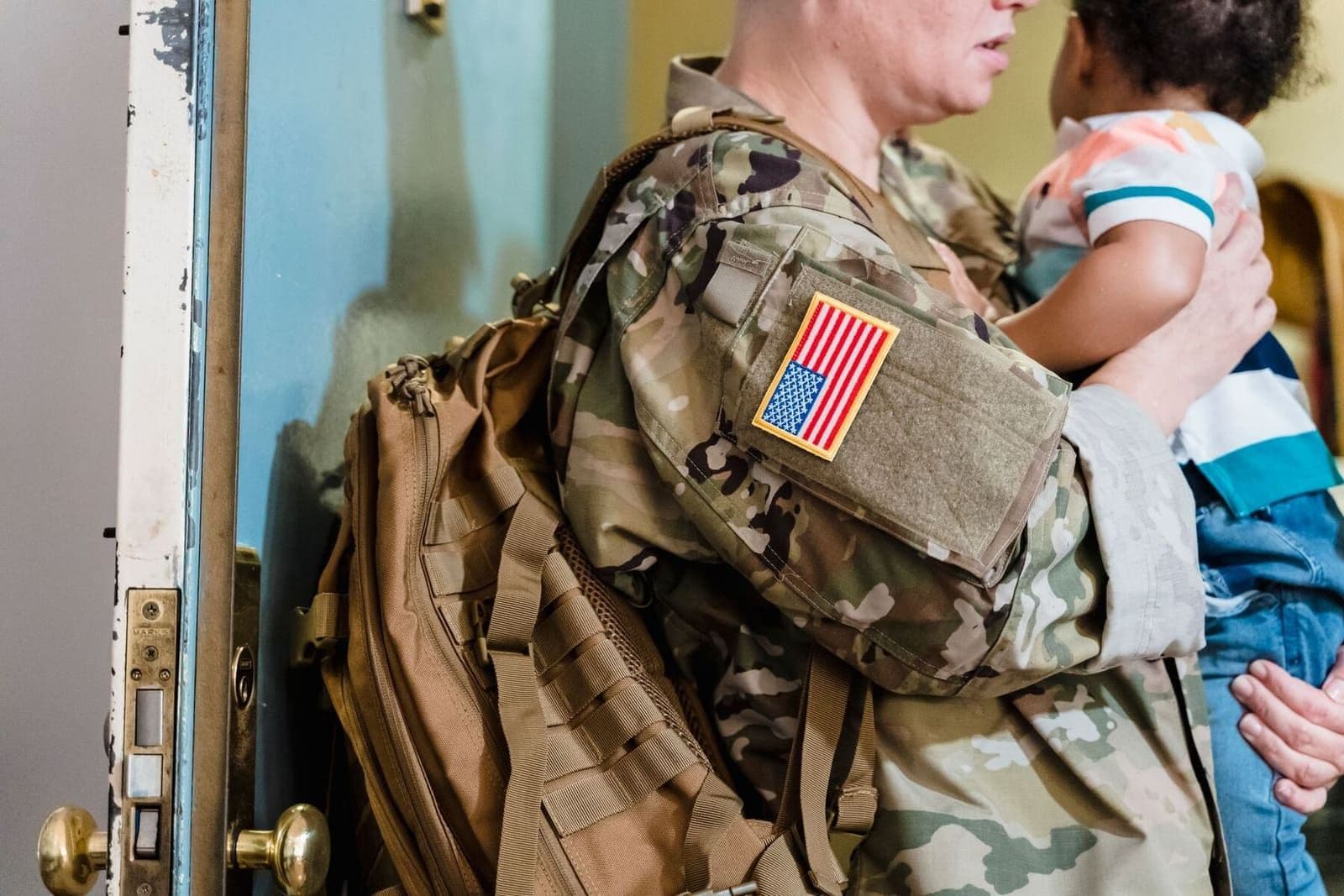
A staff sergeant clears out his barracks room, drives off base for the last time, and assumes his family is still covered. Six months later, it isn’t. Here’s the briefing that prevents that.
Military life insurance comes in three forms. SGLI is the automatic, low-cost coverage you carry while you serve, up to $500,000. VGLI is how you keep it after you separate, by converting your SGLI. A private term policy from a civilian carrier is the third path, and it can sit alongside either one. SGLI and VGLI are run by the VA.
Leaving the service or just left? Check your coverage. A licensed professional will explain what happens to SGLI, how VGLI works, and where private coverage fits. Free, no obligation, and keeping the VA option is a fine answer.
SGLI: coverage while you serve
SGLI, Servicemembers’ Group Life Insurance, is the life insurance that comes with service. For active-duty members and certain reservists it’s automatic: you’re enrolled at the maximum unless you choose a lower amount or opt out. Coverage runs up to $500,000, offered in $50,000 increments, and the premium stays low because it’s a group plan covering a large eligible population at one flat rate.
The detail that catches people off guard is the end date. SGLI is tied to your service, so it ends shortly after you separate. There’s a short grace period of free coverage after separation, but it’s brief, and once it lapses, that protection is gone unless you’ve already set up what comes next. The VA confirms the current amounts and grace-period rules on its SGLI pages.
- Who it covers. Active-duty members and certain reservists, automatically.
- How much. Up to $500,000, in $50,000 increments.
- What it costs. A low, flat group rate while you serve.
- When it ends. Shortly after you separate from service.
Worth knowing: SGLI also includes coverage for a spouse and dependent children through Family SGLI, and a separate program, TSGLI, pays a benefit for certain traumatic injuries. Those are coverages many families never think to check.
For the survivor side, see how an SGLI claim is filed and paid, including why SGLI has no loan feature.
VGLI: coverage after you separate
VGLI, Veterans’ Group Life Insurance, is the bridge from service coverage to veteran coverage. It lets you continue your protection after you separate by converting from SGLI. You can carry up to the amount of SGLI you held, to a maximum of $500,000, and the policy is yours to keep for life as renewable, term-style group coverage.
Two features define VGLI. First, the health window: no health questions are asked if you apply within 240 days of separation. You can apply later, up to 1 year and 120 days from separation, but health questions may apply after that first window closes. Second, the pricing: VGLI is group term coverage whose premiums increase with age in five-year bands. It holds steady within a band, then steps up as you move into the next. For the full chart, see our VGLI rates guide and the deeper comparison in SGLI vs. VGLI.
Private life insurance options
Private life insurance is a policy you buy from a civilian carrier, and for many military families it’s the piece that closes the gap. SGLI caps at $500,000. A mortgage, a couple of vehicles, and the cost of raising and educating children can run well past that. A private term policy (coverage for a set number of years, like 20 or 30) lets you add protection on top of your government coverage, often for a modest monthly premium when you’re young and healthy.
Here’s the difference from VGLI. A private term policy is individually underwritten, meaning the carrier reviews your age and health to set the price. In good health, that can mean a level premium locked for the whole term, it doesn’t step up every five years the way VGLI does. The tradeoff is the underwriting itself: if you have a service-connected or other condition, a private policy can cost more or be harder to qualify for, which is exactly where VGLI’s no-health-questions window earns its keep.
- When private term shines. Good health, a long horizon, and a need above the $500,000 SGLI ceiling.
- What it adds. A level premium for the term, and coverage that isn’t tied to your service status.
- What to confirm. Whether the policy has a military service or aviation clause, some older or specialty policies do; most modern term policies cover service members normally.
The three paths, side by side
The same questions answer all three programs. Here they are next to each other, so you can see where each one fits. The dollar figures are illustrative ranges to show the shape of the cost, not quotes. Your own numbers depend on your age, health, and coverage amount.
| Question | SGLI | VGLI | Private term |
|---|---|---|---|
| Who it’s for | Active-duty members and certain reservists, automatically. | Veterans continuing coverage after service, by converting SGLI. | Anyone who qualifies, military or civilian, stacks on top. |
| Max coverage | Up to $500,000, in $50,000 increments. | Up to the SGLI amount you held, to $500,000 max. | Set by the carrier and your underwriting, often higher. |
| Health questions | None, automatic while you serve. | None within 240 days of separation; may apply after. | Yes, individually underwritten on age and health. |
| How cost behaves | Low, flat group rate that doesn’t climb with age. | Group term in 5-year bands, steps up with age. | Level premium locked for the term when bought healthy. |
| Illustrative monthly cost* | Roughly $25 for $400,000 while serving. | Lower in your 30s, higher in your 50s by band. | Often $20 to $45 for a healthy 30-something, 20-yr term. |
| When it ends | Shortly after you separate from service. | Renewable for life as long as premiums are paid. | At the end of the term, or when you stop paying. |
*Illustrative ranges to show the shape of cost, not quotes. SGLI and VGLI figures and rules are set by the VA (va.gov/life-insurance). Private rates vary by carrier and underwriting. Confirm current numbers before deciding.
Which path fits you (a framework)
There’s no single right answer, so use a short framework instead of a verdict. Run your situation through three questions, in order, and the path usually becomes clear.
- 1.Are you still serving? Then SGLI is already working for you. The question is whether $500,000 is enough, if not, a private term policy on top is the common fix.
- 2.Are you separating or recently out? Decide on VGLI first, because the 240-day no-health-questions window is time-sensitive. You can always add or compare private coverage after, but the VGLI window won’t reopen.
- 3.How’s your health? In good health with a long horizon, price a private term policy, a locked premium can cost less over the years. With a service-connected or other condition, lean on VGLI’s no-health-questions window, and keep it.
For most military families the honest answer isn’t SGLI or VGLI or private, it’s a combination. A government program for the certain, can’t-be-cancelled base, and a private policy to reach the total your family actually needs. If you already hold a policy and want a second set of eyes, a free policy review can confirm where you stand in one unhurried call.
Free · No obligation
Know your coverage before you need it.
A licensed professional will go through your military coverage with you, compare it with private options, and tell you plainly if what you have is already the right fit. Free, with no obligation.
- What happens to your SGLI after you separate
- How VGLI works and what it costs by age
- Private coverage next to VGLI
- Naming and updating beneficiaries
Helping families since 2000. Licensed in all 50 states.
Mon-Sat · 10am-9pm
Retired military: what changes
For retired military life insurance, the options are the same, the timeline is what shifts. Retiring is a separation, so your SGLI still ends shortly after, and you can convert to VGLI within the same window: up to 1 year and 120 days, with no health questions in the first 240 days. The clock starts the day you retire, not the day your benefits begin.
Two things change in practice for retirees. First, age matters more for private coverage, a term policy bought at 60 costs more than one bought at 40, so the math between VGLI’s age bands and a new private premium gets closer. For veterans in their 70s and beyond, life insurance for veterans over 70 shows which VA plan is still open at each age. Second, retirees often already carry coverage from earlier in their careers, which makes this a review decision rather than a from-scratch one: what to keep, what to convert, and whether there’s still a gap. The VA keeps current figures and any rule changes on VA.gov.
When to keep what you already have
Sometimes the right move is to change nothing, and a good review will tell you so. If you’re still serving and your SGLI comfortably covers your debts and your family’s needs, you’re done; there’s nothing to fix. If you’re a veteran already holding VGLI because a health condition makes private coverage costly, keeping it is usually the smart call, and switching to chase a slightly lower rate could cost you the very acceptance you already have.
The same goes for a private term policy you bought years ago at a good rate when you were younger and healthier, that locked premium is often worth holding, even if a new shopping trip looks tempting. We’ll say it plainly: a review that ends in “keep what you have” is a successful review. You only need to act when there’s a real gap or a window closing, not because someone told you to. If you do decide a private policy has run its course, the steps follow the company that issued it. A USAA life policy, for example, is not ended the way USAA auto or home coverage is, and how to cancel a USAA life insurance policy walks through what to check first.
Free · No obligation
Read this far? Put your own numbers to it in one free review.
A licensed professional will weigh your SGLI, any VGLI window, and a private quote against your family’s actual need, and say plainly which path fits. If keeping what you have is the right move, that’s the answer you’ll get.
Mon-Sat · 10am-9pm
Questions military families ask about life insurance
01What is military life insurance?
Military life insurance is the life coverage tied to service and the options that follow it. While you serve, SGLI (Servicemembers’ Group Life Insurance) gives you up to $500,000 of automatic, low-cost group term coverage. After you separate, VGLI (Veterans’ Group Life Insurance) lets you convert that coverage and keep it for life. Private term policies from civilian carriers are the third path, and they can sit alongside either one.
02Is SGLI enough life insurance for a military family?
It depends on your obligations. SGLI tops out at $500,000, which is meaningful, but a common rule of thumb is 10 to 12 times your income, and a mortgage plus future college costs can pass that ceiling fast. Many service members keep their full SGLI and add a private term policy to close the gap. The right number is the one that covers your debts, your family’s living costs, and the years of income you’d want to replace.
03Should a veteran keep VGLI or buy private life insurance?
For a veteran in good health with a long horizon, an individually underwritten term policy can cost less over the years, because it locks one premium for the whole term instead of stepping up by age band. For a veteran with a service-connected or other health condition that makes private coverage costly or hard to qualify for, VGLI is often the surer path, since within 240 days of separation it asks no health questions. Many veterans use both. Looking at the two side by side for your own situation is the honest way to decide.
04Does retired military life insurance work differently from active-duty coverage?
The core options are the same, but the timeline shifts. Retiring from the military is a separation, so your SGLI still ends shortly after, and you can convert to VGLI within the same window, up to 1 year and 120 days, with no health questions in the first 240 days. Retirees also tend to weigh private term coverage carefully, since age and any health changes affect the price of new policies. The VA confirms the current rules on its life insurance pages.
05Can I have SGLI, VGLI, and a private policy at the same time?
You can hold private life insurance alongside SGLI while you serve, and alongside VGLI after you separate, there is no rule against carrying more than one policy. You cannot hold SGLI and VGLI at the same time, because VGLI is the conversion of SGLI after service. Stacking a government program with a private term policy is one of the most common ways military families reach the total coverage they actually need.
06How much does military life insurance cost?
SGLI is a low, flat group rate while you serve, the same per $1,000 of coverage regardless of age. VGLI is group term priced in five-year age bands, so the premium holds steady within a band and steps up as you move into the next one. Private term rates depend on your age, health, and the term length you choose. Because each is priced differently, comparing them band by band against your own timeline is the only way to see the real cost.
07Is military life insurance taxable?
Life insurance death benefits are generally paid to your beneficiaries income-tax-free under federal law, whether the coverage is SGLI, VGLI, or a private policy. That said, large estates can face separate estate-tax rules, and your situation may differ. This page is educational and not tax or legal advice, the IRS explains the general treatment of life insurance proceeds, and a tax professional can confirm what applies to you.