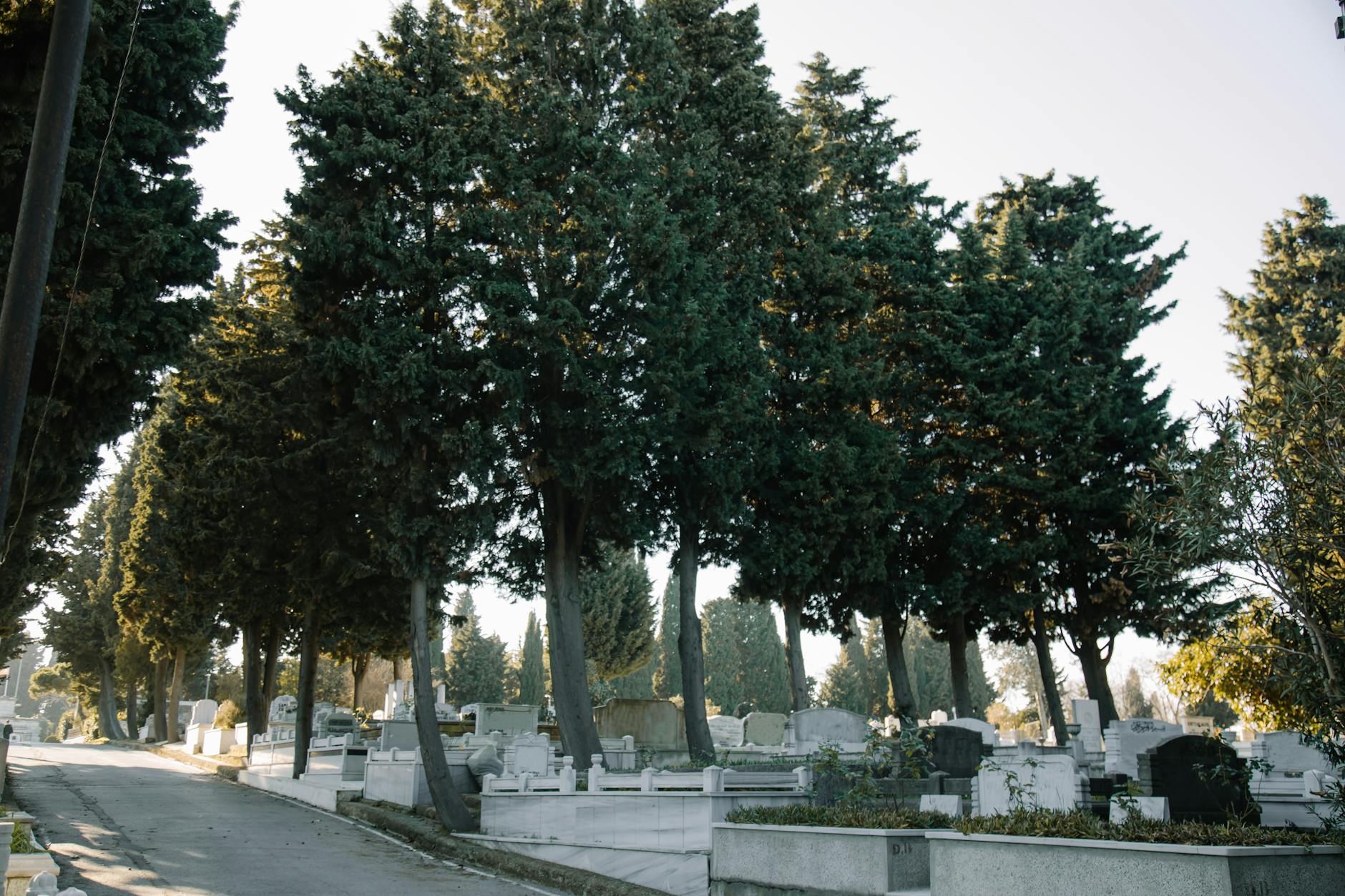
A daughter calls a cemetery to ask one simple question (what does a plot cost?) and gets four numbers back. Here’s how to read them.
How much does a cemetery plot cost? A single plot typically runs $1,000 to $5,000 at a public cemetery and roughly $5,000 to $10,000 or more at a private one. The range is wide on purpose: price depends heavily on where you are and which cemetery you choose. And the plot itself is only one line on the bill.
Pricing a plot ahead of time? A free, no-pressure conversation with a licensed professional, so your family never has to guess at the total.
What a cemetery plot costs
For a single in-ground plot, most families see somewhere between $1,000 and $5,000 at a public cemetery and $5,000 to $10,000 at a private one. Reported prices stretch wider still, from a few hundred dollars in some rural areas to $25,000 or more in the priciest cities. Those national figures come from consumer-resource guides such as Choice Mutual and Lincoln Heritage, which line up closely with one another.
One piece of context helps the number make sense. When the National Funeral Directors Association reports a median funeral cost of $8,300 for a service with viewing and burial (its 2023 figure), that total is for the funeral home’s services. It does not include the cemetery plot, opening and closing, or a headstone. The plot is its own question, on its own line. For a deeper breakdown by space type, our guide to burial plot costs walks through every variation in detail.
Prices by plot type
“Cemetery plot” covers several different things, and the type you choose is one of the biggest drivers of price. The most common decision is how many people the space is meant for. Here are the typical ranges. Treat them as starting points, since each varies widely by region and cemetery.
| Plot type | Typical range | What it is |
|---|---|---|
| Single plot | $1,000 - $5,000 (public); $5,000 - $10,000+ (private) | One in-ground space for one person |
| Companion plot | $2,000 - $8,000 (more in cities) | Two side-by-side spaces |
| Double-depth plot | Often 1.5-2x a single space | Two in one footprint, stacked |
| Family plot | $5,000 - $25,000+ | A small block of spaces bought together |
| Cremation / urn plot | $350 - $2,500 | A smaller space for cremated remains |
| Mausoleum crypt | $4,000 - $12,000 (single) | Above-ground entombment |
Illustrative ranges, not a quote. They vary widely by region and by cemetery. Use them as a starting point, then confirm with the cemetery’s own price list.
A few of these are worth a plain-English word. A companion plot holds two people side by side. A double-depth plot holds two in the same footprint, one above the other, which can lower the per-person ground cost. A family plot is a small block of spaces bought together. A cremation or urn plot is a smaller space for cremated remains, and usually the most affordable option of all.
Fees the plot price leaves out
This is the part that surprises families most, so it’s worth itemizing plainly. The price of the plot rarely includes the charges below, and together they can equal or exceed the plot itself.
- Opening and closing the grave. The labor to dig and fill the grave on the day of the service, commonly $1,000 to $2,500 for a casket, and less for cremated remains. This is almost always separate from the plot.
- A burial vault or grave liner. Many cemeteries require an outer container around the casket so the ground stays level. A basic liner often runs $800 to $1,500; a vault can range from roughly $1,500 to $7,500 depending on materials.
- A headstone or marker, plus installation. A flat marker can be a few hundred dollars; an upright or custom monument commonly runs $1,000 to $3,000, with a setting fee added on top.
- Perpetual (endowment) care. A fee that funds ongoing upkeep of the grounds, sometimes folded into the plot price, sometimes billed separately as a few hundred dollars or a percentage of the plot.
Cemetery plot prices near you
The honest answer to “what do cemetery plots cost near me” is that location moves the price more than anything else. The same kind of plot can cost several times more in a dense metropolitan area than in a rural county, simply because land is scarcer and more expensive near big cities. Coastal and West Coast metros tend to sit at the high end; many rural and Midwest areas sit at the low end.
What this means for planning is practical, not discouraging. If one cemetery feels out of reach, a nearby town (or a public cemetery a little farther out) can change the number meaningfully. It’s worth gathering two or three local price lists before you settle, since the only price that’s truly yours is the one a specific cemetery quotes for a specific space.
Not sure how it all adds up? A licensed professional can total the plot and the costs around it with you, calmly, in plain English, and only if you want the help.
How to buy a cemetery plot
Buying a cemetery plot is more straightforward than most families expect. You contact the cemetery, choose a section and a space, and sign paperwork. Here’s the order it usually goes:
- 1.Call or visit the cemetery office. Ask for the full price list (the plot, opening and closing, any required vault, and care fees) so you’re comparing complete totals, not just the plot.
- 2.Choose a section and space. Cemeteries are laid out in sections, and price can vary within the grounds. Walk it if you can; people often have a strong sense of the right spot.
- 3.Sign the deed of interment. What you buy isn’t the land. It’s the right of interment, meaning the right to be buried in that space. Keep the deed somewhere your family can find it.
- 4.Decide pre-need or at-need. Buying ahead (pre-need) locks in today’s price and removes a hard decision from a hard day. Buying at the time of need is also common. There’s no wrong choice, only what fits.
One term worth slowing down on: a deed of interment is not a property deed. It grants the right to use the space for burial under the cemetery’s rules. That distinction matters most when plans change later, which is the next question families ask.
Selling or transferring a plot you no longer need
Yes, you can usually sell or transfer a cemetery plot you no longer need, but the cemetery sets the rules, so start there. Plans change: a family moves across the country, chooses cremation, or simply ends up with an extra space. A few paths are common.
- Sell it back to the cemetery. Many cemeteries will buy a plot back, though usually at the original purchase price rather than today’s higher value. It’s the simplest route when it’s offered.
- Resell privately, with approval. Some cemeteries allow a private sale to another family, subject to their sign-off and a transfer fee. The plot stays tied to that cemetery, so the buyer is someone who wants that location.
- Transfer it to a relative. A plot can often be passed to a family member by updating the deed of interment through the cemetery office. This is frequently the easiest option of all.
Calm ways families plan ahead
There’s no pressure to decide any of this today. For families who’d like to plan ahead (grieving now, or simply thinking it through in a quiet moment) a few approaches tend to bring peace of mind. Planning ahead is, more than anything, a gift to the people who would otherwise have to decide under pressure.
- Buy the plot ahead of time. Pre-purchasing can lock in today’s price before cemetery costs rise, and it removes one hard decision from a hard day. The trade-off: a plot ties you to one cemetery, so it helps to be reasonably settled on where.
- Check veteran eligibility first. For eligible veterans, a plot in a VA national cemetery is provided at no cost, along with opening and closing and a government marker, per VA.gov. Many families simply don’t know to ask.
- Set the money aside in advance. Some families earmark savings; others use a small life insurance policy (often called final expense or burial insurance) designed to pay quickly to whoever is handling arrangements, so the plot and related costs are covered without touching other savings.
That last option is worth a calm, honest word. A small final expense policy is simply life insurance kept small and straightforward, with the everyday costs of a burial in mind: the plot, the service, and what comes with them.
Here’s the honest part. It isn’t the right fit for everyone. If you’ve already set money aside, or a VA national cemetery covers the plot, you may not need a policy at all, and a good review can end with “keep what you have.” That’s a successful review. If it would help to talk through which approach fits your situation, a free policy review with a licensed professional walks through it with no pressure and no obligation.
Free · No obligation
Planning ahead is a gift. We’ll help you think it through.
A licensed professional can walk you through how families cover a cemetery plot and the costs around it, calmly, in plain English, with no pressure and no obligation. If you’re already set, you’ll hear exactly that.
Mon-Sat · 10am-9pm
Questions people ask about cemetery plot costs
01How much does a cemetery plot cost on average?
A single cemetery plot usually costs between $1,000 and $5,000 at a public cemetery and roughly $5,000 to $10,000 or more at a private one. The range is wide because price depends heavily on the area and the cemetery itself. The plot’s own price list is the only figure that’s truly yours.
02Why do cemetery plot prices near me differ so much from another town?
Location is the biggest reason. The same kind of plot can cost several times more in a dense metro area than in a rural county, because land near big cities is scarcer and more expensive. A public cemetery a little farther out, or in a neighboring town, often changes the number meaningfully.
03How do you buy a cemetery plot?
You contact the cemetery directly, choose a section and plot, and sign a deed of interment, which gives you the right to be buried there, not ownership of the land itself. You can buy ahead of time (pre-need) or at the time of need. Ask for the full price list, including opening-and-closing and any required vault, before you sign.
04Can you sell a cemetery plot you no longer need?
Often, yes, though the rules belong to the cemetery. Many cemeteries will buy a plot back, usually at the original price rather than today’s, and some let you resell privately with their approval and a transfer fee. Read the deed of interment and call the cemetery office first, since selling almost always runs through them.
05Does the cemetery plot price include opening and closing the grave?
Usually not. The opening-and-closing fee (the labor to dig and fill the grave on the day of the service) is almost always separate, commonly $1,000 to $2,500 for a casket burial. Always ask whether it’s included before you compare two cemeteries by plot price alone.
06Are veterans entitled to a free cemetery plot?
Eligible veterans can be buried at no cost for the plot in a VA national cemetery, which also includes opening and closing, a grave liner, and a government headstone or marker. Eligibility and details are explained on VA.gov. Many families don’t realize the benefit exists until they ask.
07How do families usually pay for a cemetery plot?
Some pay the cemetery directly or pre-purchase the plot. Others use a small life insurance policy (often called final expense or burial insurance) designed to leave money quickly to whoever is handling arrangements, so the plot and the costs around it are covered without dipping into savings.