
Most Americans own life insurance, most who do not say they should, and almost everyone thinks it costs more than it does. Here are the numbers, each one sourced, current, and free to cite.
About 51% of U.S. adults have life insurance, roughly 100 million say they need it or need more, and adults under 30 overestimate the price of a basic term policy by 10 to 12 times, according to the LIMRA and Life Happens 2025 Insurance Barometer Study. The sections below break down ownership, the coverage gap, the cost gap, and the size of the industry, with the primary source linked on every figure.
Who owns life insurance
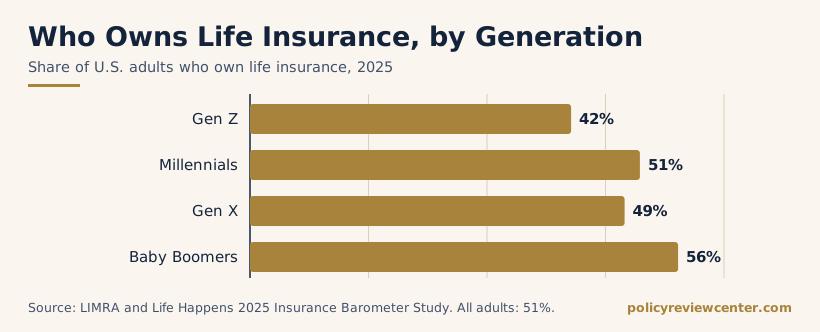
About 51% of American adults owned life insurance in 2025, a figure that has held near half the population for years, per the 2025 Insurance Barometer Study from LIMRA and Life Happens. Ownership rises with age and income, and women are a little more likely to be covered than men.
| Group | Own life insurance |
|---|---|
| All adults | 51% |
| Women | 54% |
| Men | 48% |
| Baby Boomers | 56% |
| Gen X | 49% |
| Millennials | 51% |
| Gen Z | 42% |
U.S. life insurance ownership, 2025 (LIMRA and Life Happens Insurance Barometer Study)
The coverage gap
Owning a policy is not the same as owning enough. About 100 million U.S. adults, roughly 40% of consumers, say they either need life insurance or need more of it, according to the 2025 study. The gap is widest among younger adults: more than half of Gen Z and Millennials who say they are not knowledgeable about coverage report having a gap they recognize but have not closed.
That gap is the practical reason a second opinion matters. Knowing whether your coverage actually matches what your family would need is exactly what a free policy review and our how much life insurance you need guide are built to answer.
The cost misperception
The single most consequential statistic in the whole study is about price. Healthy adults aged 18 to 30 overestimate the cost of a $250,000 20-year term policy by 10 to 12 times its real price, and about three in four adults overestimate the cost of coverage overall, per LIMRA and Life Happens. In plain terms: most people believe life insurance is out of reach when, for a healthy young adult, level term coverage is often one of the least expensive financial products they will ever buy. Our term life insurance guide shows what it actually tends to cost by age.
The industry by the numbers
Life insurance is one of the largest promises in the U.S. economy. These figures come from the American Council of Life Insurers (ACLI) Life Insurers Fact Book.
| Measure | Amount |
|---|---|
| Total life insurance in force | $22.2 trillion |
| Individual life protection in force (end of 2024) | $14.1 trillion |
| Death benefits paid (2023) | $89 billion |
| Total industry assets | $9.3 trillion |
U.S. life insurance industry (American Council of Life Insurers)
How people shop for it
Where people go for answers has changed fast. 62% of adults, and 80% of those under 45, now use social media to research financial or insurance products, up from just 29% in 2019, per the 2025 study. That shift is why plain, sourced, human-reviewed information (rather than a sales pitch) matters more than it used to.
End-of-life costs
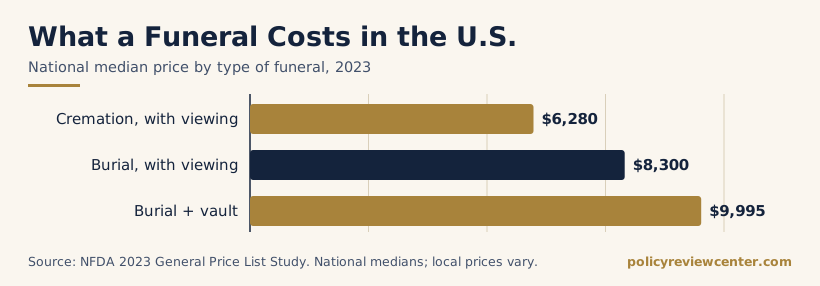
One of the most common reasons families buy a small policy is to cover final expenses. The national median funeral runs $8,300 with viewing and burial and $6,280 with cremation, per the National Funeral Directors Association 2023 study.
For the full breakdown and how families plan for it, see our guides to funeral costs and final expense insurance.
Free · No pressure
Not sure if you are in the covered half or the gap?
A licensed agent will tell you plainly whether your coverage matches what your family would need, and what it would really cost to close any gap. No pressure, nothing to buy.
- Plain answers about life insurance
- Reading a policy you already own
- Beneficiary, billing and premium questions
- Comparing options if you want them
Helping families since 2000. Licensed in all 50 states.
Mon-Sat · 10am-9pm
Quick answers
01What percentage of Americans have life insurance?
About 51% of American adults own life insurance, according to LIMRA and Life Happens 2025 Insurance Barometer Study. Ownership is highest among Baby Boomers (56%) and lowest among Gen Z (42%), and women (54%) are somewhat more likely to be covered than men (48%).
02How many Americans are underinsured or have no life insurance?
Roughly 100 million American adults say they need life insurance or need more of it, a coverage gap of about 40% of consumers per the 2025 Insurance Barometer Study. The gap is widest among younger adults who say they are not knowledgeable about how coverage works.
03Do people overestimate the cost of life insurance?
Yes, by a wide margin. Adults age 18 to 30 overestimate the cost of a $250,000 20-year term policy by 10 to 12 times its actual price, and about three in four adults overestimate the cost overall, per LIMRA. The real price of term life for a healthy young adult is often far lower than people assume.
04How much life insurance is in force in the United States?
There is a record $22.2 trillion of life insurance in force in the U.S., including about $14.1 trillion of individual life protection at the end of 2024, according to the American Council of Life Insurers. The industry paid roughly $89 billion in death benefits in 2023.
05How much does a funeral cost?
The national median is $8,300 for a funeral with viewing and burial and $6,280 with cremation, per the National Funeral Directors Association 2023 study. Those figures are a common reason families buy a small final expense policy.