
It’s one of the first questions families ask, and there’s no wrong reason to ask it. Knowing the difference simply makes the choice easier to sit with.
Cremation runs about $2,000 less than burial. The national median is $6,280 for a funeral with viewing and cremation versus $8,300 with viewing and burial, according to the National Funeral Directors Association’s 2023 study. Add a burial vault and burial rises to $9,995. A direct cremation is the most economical option of all.
Deciding between cremation and burial? A free, no-pressure conversation with a licensed professional, so the choice, and the cost, are clear before anything is needed.
The real cost difference, side by side
The clearest national numbers come from the National Funeral Directors Association, the largest organization of funeral professionals in the country. Its 2023 General Price List Study puts a funeral with viewing and burial at a median of $8,300, and the same funeral with cremation at $6,280, a difference of about $2,000. Here are the headline figures at a glance:
| Option | Median cost | What’s included |
|---|---|---|
| Funeral with viewing + burial | $8,300 (+vault $9,995) | Funeral home services, a viewing, a ceremony, and a metal casket. Add a burial vault and the median rises to $9,995. A cemetery plot is separate. |
| Funeral with viewing + cremation | $6,280 | The same professional services, viewing, and ceremony, with a cremation container and an urn in place of the casket and vault. Often no cemetery plot. |
| Direct cremation | ~$2,000 to $2,600 | The cremation itself, without a viewing or formal service. The most economical option, and a memorial can still be held later, on the family’s terms. |
Median costs (NFDA 2023); vary by region and choices. Funeral-home medians cover services and a casket or container, not the cemetery plot, headstone, flowers, or obituary. Source: NFDA 2023 General Price List Study.
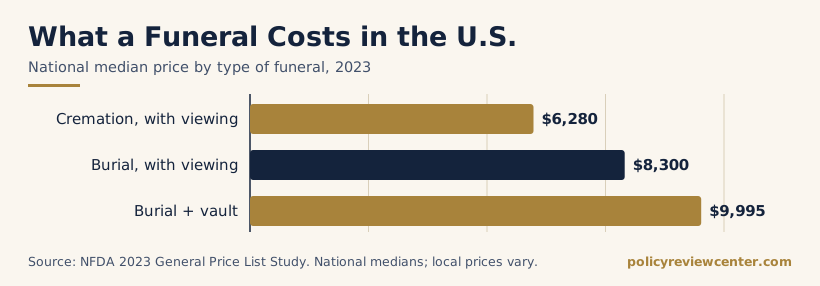
“Median” simply means the middle: half of funerals cost more, half cost less. It’s a steadier guide than an average, which a few very large or very small funerals can pull off-center. And these figures cover the funeral home’s services. The cemetery plot, headstone, flowers, and obituary are billed separately, a point our full guide to funeral costs walks through line by line.
Where the gap actually comes from
It helps to know that cremation and burial share most of the same bill. The professional services fee, a viewing, a ceremony, transportation: those lines are largely the same either way. The roughly $2,000 difference traces to a short list of material and cemetery items that a burial includes and a cremation usually doesn’t:
- A metal casket. The median metal burial casket sits at $2,500, and it’s the single widest range on the list. A cremation uses a simpler cremation container instead.
- A burial vault. An outer container that lines the grave, the line that moves the burial median from $8,300 to $9,995. Cremation doesn’t call for one.
- A cemetery plot. The piece of ground itself, bought from the cemetery, plus the charge to open and close the grave. Cremation often involves no plot. See our guide to burial plot costs for the ranges.
- An urn instead. A cremation replaces the casket and vault with an urn, which is typically a far smaller expense.
Direct cremation: the most economical path
The most economical choice overall is a direct cremation: the cremation itself, carried out without a viewing or formal service beforehand. It frequently costs a few thousand dollars or less, commonly in the range of $2,000 to $2,600, because it sets aside embalming, the viewing, and the larger material items. Our guide to cremation costs walks through that route in the same plain detail.
Choosing a direct cremation doesn’t mean skipping the goodbye. Many families hold a memorial afterward, whenever and wherever feels right: at home, in a place of worship, or somewhere that meant something to the person. It simply separates the gathering from the arrangements, which can ease both the cost and the timing in a hard week.
Choosing between the two
Cost is one part of the decision, and rarely the largest. For most families, cremation or burial is a personal and often deeply held choice, shaped by faith, family tradition, and what brings comfort. A few things tend to guide it:
- Faith and tradition. Some families have a clear preference rooted in belief or custom. That preference usually comes first, and the costs follow from it.
- A place to visit. A burial plot or a niche gives loved ones a fixed place to return to. Some families find that comforting; others prefer keeping or scattering ashes somewhere personal.
- Flexibility of timing. Cremation can give a family room to gather everyone for a memorial later, rather than within a few days.
- Budget, calmly weighed. The roughly $2,000 difference (more with a vault and plot) is real, and there’s no shame in letting it inform the choice.
Neither path is more respectful than the other. The right choice is simply the one that fits your family, and either can be done with full dignity.
How costs vary by region and by choice
Two families can plan the same kind of service and see very different totals. The national median is a starting point, not a quote, and two things move it most: where you are, and what you choose.
- Region. Funeral and cemetery prices tend to run higher in large metropolitan areas and along the coasts, and lower in smaller towns and rural areas. A cemetery plot alone can differ by thousands.
- Cremation or burial. The single biggest lever, worth about $2,000 at the median, more once a vault and plot are added.
- Viewing and ceremony. A full viewing, a formal service, and printed programs each add a line, whichever path you take. A smaller, simpler gathering costs less and asks nothing of the family’s dignity.
- Direct vs. traditional. A direct cremation or immediate burial sets aside the viewing and several material items, which is where the largest savings sit.
This is exactly why a phone call to two or three nearby funeral homes is time well spent. They’re required to quote prices over the phone, and the spread between them, for the very same services, can be real.
How families plan ahead
Whichever path a family leans toward, handling it ahead of time is a kindness. Most families cover these costs one of three ways: savings set aside for the purpose, a pre-need contract with a funeral home, or a small life insurance policy bought for exactly this. Many use a blend.
Money set aside. The simplest path: a dedicated savings account, sometimes one that passes straight to the person handling arrangements. The advantage is full flexibility; the work is making sure the amount is actually there, and that someone knows where it is.
A pre-need contract. Arranging (and often paying for) a cremation or burial with a specific funeral home in advance. The appeal is real: you lock in today’s prices and spare your family the decisions. Worth confirming calmly: how your money is protected, what happens if you move, and whether the plan travels with you.
Final expense life insurance. A small whole life policy, often called final expense or burial insurance sized to cover these costs, with the benefit paid to a person you name rather than tied to one funeral home. It keeps the choices in the family’s hands and the money portable. As with any coverage, the question worth asking is whether the policy is the right fit and the right size, which is the kind of thing a free, unhurried conversation can confirm.
There’s no single right answer. The right one is the one that fits your family, and a decision made calmly now is one your family won’t have to make in a single hard week.
Free · Unhurried · No pressure
Deciding between cremation and burial?
A licensed professional will walk through your options for covering either choice: savings, pre-need, or a small policy, with no pressure. If you’re already set, you’ll hear exactly that.
- What final expense coverage can pay toward
- Claims paperwork if a loved one had a policy
- Planning ahead so costs are settled early
- Comparing plans for your age and health
Helping families since 2000. Licensed in all 50 states.
Mon-Sat · 10am-9pm
Questions people ask about cremation and burial
01Is cremation cheaper than burial?
Yes, at the national median. A funeral with viewing and cremation runs $6,280, while a funeral with viewing and burial runs $8,300, about $2,000 more, according to the National Funeral Directors Association’s 2023 study. Add a burial vault and the burial figure rises to $9,995. A direct cremation, with no viewing or ceremony, is the most economical path of all, often around $2,000 to $2,600.
02How much does cremation cost?
A cremation with a viewing and ceremony runs a national median of $6,280, per the NFDA’s 2023 General Price List Study. A direct cremation, the cremation itself, without a formal viewing or service, is the most economical option, frequently a few thousand dollars or less, commonly in the range of $2,000 to $2,600. The figure depends on your region, the provider, and the services chosen.
03Why is burial more expensive than cremation?
The gap traces to a few specific lines. A burial funeral typically includes a metal casket, a burial vault, and a cemetery plot. A cremation replaces the casket and vault with a cremation container and an urn, and it often involves no plot at all. The professional services, viewing, and ceremony can be just as full either way. The difference is mostly in those material and cemetery items.
04What is a direct cremation?
A direct cremation is the cremation itself, carried out without a viewing or formal ceremony beforehand. The family is free to hold a memorial whenever and wherever feels right: at home, in a place of worship, or somewhere meaningful. Because it sets aside the viewing, embalming, and the larger material items, it is the most economical option overall, often around $2,000 to $2,600.
05Is cremation less respectful than burial?
No. Neither choice is more respectful than the other. It is a personal and often deeply held decision, shaped by faith, family tradition, and what brings comfort. Many families who choose cremation hold a memorial later, on their own terms, and find it every bit as meaningful. The right choice is simply the one that fits your family.
06How do families pay for either choice?
Commonly through savings set aside for the purpose, a pre-need contract arranged with a funeral home, or a small life insurance policy (often called final expense or burial insurance) sized to cover these costs. Many families use a combination. Each approach has trade-offs worth weighing calmly, ideally before the need arrives.